
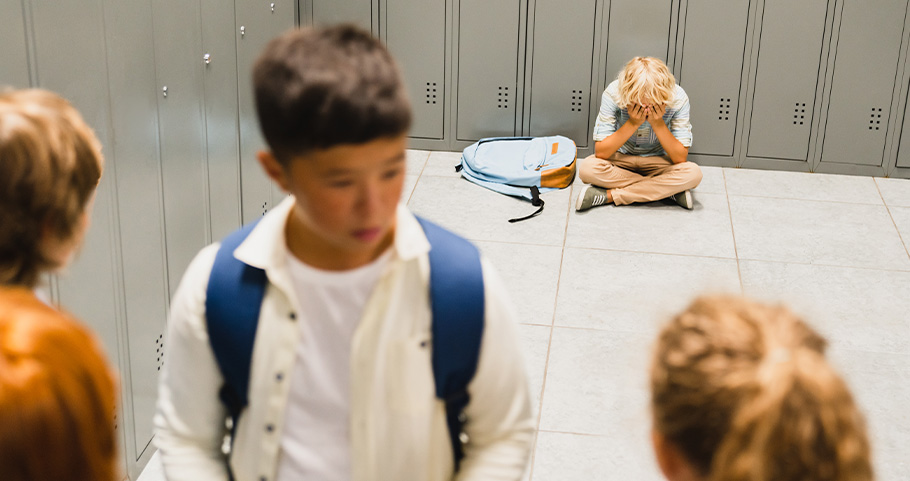
As it sounds with its name, disability bullying is bullying of students with special needs because they have a disability, IEP or Section 504 Plan. But how do we define bullying?
Each State has their own definition of disability bullying. For example, in California, bullying is defined as, “any severe or pervasive physical or verbal act or conduct, including electronic acts (cyberbullying), that causes or is reasonably predicted to cause fear or harm to a student’s person or property, or substantially interferes with their academic performance, health or ability to participate in school activities” (Cal. Ed. Code 48900(r).
Let’s break that down:
- Severe or pervasive
- Physical, verbal or electronic
- Causes or could be reasonably expected to cause
- Fear, harm or substantially interfering with academic performance, health or ability to participate in school activities
As you can see from the definition of bullying in California, bullying can be physical (ie being hit, pushing, shoving), verbal (ie slurs, mental abuse, hate language, the “r” word) or electronic (cyber bullying, hateful text messages, harassing phone calls). Disability bullying can cause harm to a student with disability’s mental health, including depression, anger and anxiety. It can even lead a student with a disability to be hospitalized or, worse, commit suicide. Cyber bullying does not have to take place within the school setting for it to be considered disability bullying that needs to be addressed by a school. Disability bullying can also include sexual harassment. It can also include someone setting up a fake profile on social media for the student with a disability. It can also mean excluding a student with a disability from activities simply because they have a disability.
How Common Is Bullying of Special Needs Students?
Although statistics vary, it seems that 60% of students with disabilities are bullied, compared to 24% of the general population.
The challenge here is that students, particularly those with an IEP or Section 504 plan, don’t necessarily report when they are being bullied. They don’t want it to get worse so they stay quiet. While this is true of all students, it is especially true of students with disabilities who may have impaired social skills, higher levels of mental health challenges or even affected speech which limits their abilities to effectively communicate instances of disability bullying.
Why Are Students with Special Needs More Vulnerable to Bullies?
So why are students with disabilities targeted more frequently than non-disabled students? Students with disabilities are perceived as being, and often are in fact, more vulnerable than their non-disabled peers. They might stand out due to physical disabilities, carrying an AAC device or displaying behaviors like shouting or screaming. Some students with disabilities may stand out because they have different social skills. They may say things that are inappropriate or “weird” which draws more attention to them.
What Are the Effects of Bullying on Students with Disabilities?
Just as with their non-disabled peers, disability bullying can cause students with disabilities to feel depression, anxiety, anger, distractibility and fear. It can cause school avoidance which leads to more absences, tardies and even parents undergoing state attendance reviews. But for students with disabilities, they are more likely to mask the impact of disability bullying because they want to fit in or be “normal”: they may pretend everything is okay, not divulge disability bullying is happening and they may internalize the emotional impact it is having on them.
Students experiencing disability bullying demonstrate increased levels of physical symptoms (ie stomachaches, migraines, headaches). Parents might see their student with disability’s grades drop dramatically. Disability bullying might cause students with disabilities to become less involved in activities they enjoy, to become more isolated or withdrawn or to drop out of school entirely. Worse still, students with disabilities who are victims of disability bullying might even commit suicide if the disability bullying goes unnoticed.
What Can Parents and Teachers Do to Prevent Special Needs Bullying?
It can be daunting to think about what to do if your student is a victim of disability bullying. If you see changes in your student with a disability that leads you to suspect they are being bullied because of their disability, IEP or Section 504 plan, you can follow these steps:
- Notify your student’s school site administration. We encourage you to do so in writing, but you could also first have a phone call with an administrator to express your concerns. Just make sure you follow up that phone call with an email summarizing your understanding of the conversation. Paper trails are very important when documenting concerns with disability bullying.
- If a restorative meeting is proposed, be cautious: while these are well-intentioned, they can cause the disability bullying to escalate. Attend the restorative meeting with your student if they are comfortable attending. Be direct in asking what the school is going to do to keep your student with a disability safe and make sure you are provided with concrete answers.
- Insist the school creates a safety plan for your student with disabilities. This should include clearly identified steps your student and staff will take if s/he is bullied again. This could also include increased adult supervision during unstructured times (ie transitions, passing periods, etc).
- Put a request in writing for the school/district to conduct an investigation into the disability bullying.
- Convene an IEP or Section 504 Meeting to:
- Document the concerns for your student due to the disability bullying
- Put in additional services and/or supports to address any declines in grades or mental health
- Improve communication systems about your student with a disability so you are kept more up to date
- Demand to know what the school/district has done to promote inclusion and tolerance, including how and when it is teaching social emotional learning.
- If cyber bullying or sexual harassment is taking place, consider filing a police report.
- Contact an educational advocate to support you in navigating through this process
How Can Students with Disabilities Be Empowered to Speak Up?
It’s easy to say that students should self advocate and seek out a trusted adult when they are being bullied because of their disability, IEP or Section 504 plan. But for students with disabilities, the fear of retaliation is all too real. Things that might be helpful for your student with a disability is to provide them with the language to express how they feel with certain peer interactions. This requires explicit instruction.For students who are nonverbal and using AAC devices, program in self advocacy words and/or icons and teach them what they mean. If your student is able, try role playing scenarios where they might need to self advocate. Watch videos on bullying, ask questions about the video along the way and give concrete examples of what the student might do in each scenario. Create a “cheat sheet” of language (verbal or icons) your student can use when s/he feels unsafe.
It’s also easy to tell students with disabilities to seek out a trusted adult or friend. There are some challenges with this strategy, however: how are we defining a trusted person? Who is deciding that person is trusted? Can the student communicate well enough with that adult to self advocate? Prior to the start of the school year, ask if it’s possible for your student to meet with their classroom teacher and case manager. If they are at the secondary level, see if your student can meet with a couple teachers and the case manager. This helps to establish rapport and to ensure the teachers are aware of your specific student, not lost in a sea of new faces.
There are often teacher-led student groups or social groups within school settings that empower students to feel safe and supported within those groups. Be proactive in asking about these. At the secondary level, there are clubs in which your student might be interested, ranging from drama to chess to anime. Helping your student connect with a peer group will give them a sense of belonging and could create a peer group that will look out for your student.
What Legal Protections Exist for Special Needs Students Facing Bullying?
While there are no specific provisions regarding disability bullying under the IDEA, Section 504 and the Americans with Disabilities Act (ADA) do have some protections prohibiting disability bullying and harassment of persons with disabilities. Under Section 504, disability-based discrimination is prohibited in schools receiving federal funding (ie public and charter schools). The ADA applies to both public and private schools, prohibiting disability-based discrimination and harassment in both settings.
If your student is being bullied or harassed because of their disability,having a Section 504 plan or IEP, notifying a school site administrator. This forces the school to investigate the bullying. They are required to provide you with a response to your investigation request, notifying you of the outcome of their investigation as well as any changes they will be making. If you are unsatisfied with the response, you can file a complaint through the district’s Uniform Complaint Procedure (UCP) or file a complaint with the Office of Civil Rights (OCR).
We strongly advise you to convene your Section 504 or IEP team to create a safety plan. The safety plan for a student with a disability will stipulate what staff and your student with a disability are to do if the student is being bullied or harassed. You should also review the Section 504 plan or IEP to ensure appropriate accommodations are in place to support your student in the event of continued bullying. If your student has an IEP, we suggest the IEP team look at the goals to make sure there are no other goals needed to support self advocacy or social communication. If your student has missed school due to disability-related discrimination or harassment, you may be entitled to compensatory services as well.
Where Can Parents and Educators Get Help?
If you are looking for support for your student with a Section 504 plan or IEP who is being harassed or bullied because of their disability and you are not finding support at school, you can:
- Contact local or national organizations: PAVE and StopBullyingNow are two places to start.
- If you are not receiving an appropriate response from site administration, contact the Director of Student Services for your district or site. Your district may also have a discipline department that may be able to assist you in getting follow up from the site.
- Contact an educational advocate to create a plan for next steps to keep your student safe.